Capabilities
From 3D file to shipped carton
One plant, one QC process, one point of contact. Everything below happens in our own factory in Dongguan — including the tooling, which is the part most suppliers subcontract and the reason their lead times move.
The plant, in numbers
| Plant | Own factory, Dongguan, Guangdong · 1,800 m² |
|---|---|
| Equipment | 30+ compression presses · 10+ CNC engravers |
| Capacity | 15,000 pcs/day |
| Tooling | In-house, CNC engraved and polished cavities |
| Tolerance | ±0.1 mm typical, depending on process |
| MOQ (trial) | 100 pcs |
| Sampling | 3–7 days |
| Lead time | 15–20 days after sample approval |
| Inspection | 100% in-line: dimension / colour / logo / fit / function |
| Testing | Third-party (SGS / Intertek / BV) arranged per order |
| Export | Shipping to 50+ countries |
| Payment | 30% deposit / 70% before shipment (T/T) |
| Incoterms | FOB Shenzhen |
We do not hold factory-level certifications. What we do instead is run in-line inspection on every batch and arrange third-party testing for your order, so the report covers the parts you receive.
Seven stages, and the day count for each
- 3D and DFM 2–5 days. We check draft, undercuts and wall thickness before steel is cut.
- Tooling 5–10 days. CNC engraved and polished in-house.
- Compounding 1–2 days. Pigmented to a Pantone chip, approved on a cured chip.
- Moulding Compression moulding, cycle 60–180 s depending on wall thickness.
- Deflashing Hand trimmed. Flash on a visible edge is our most common reject reason.
- Post-curing 200 °C for 2 hours, to drive off residual volatiles.
- Inspection and packing 100% in-line: dimension, colour, logo, fit, function.
Those day counts are for a part we have not made before. A repeat order skips the first three.
Inside the press
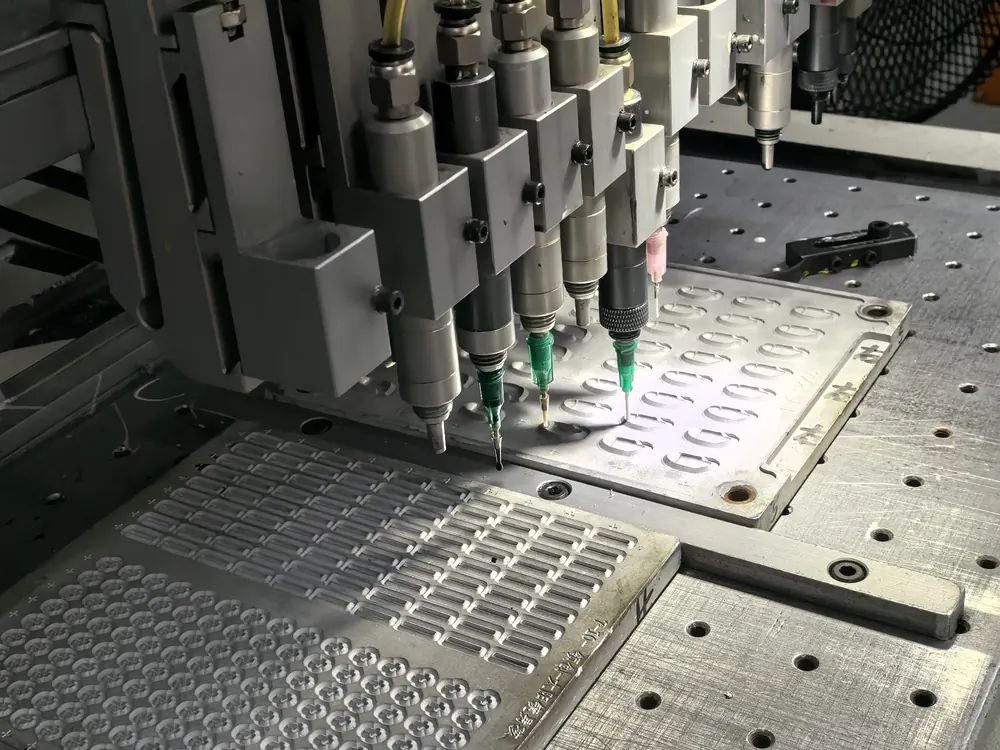
Dispensing, then compression. Two shots from the floor, unedited.
-
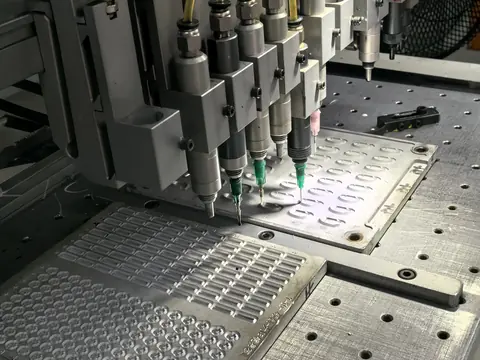
Multi-nozzle dispensing head laying colour into the cavity. Several colours in one tool means several passes — this is why a three-colour keyring costs more than a single-colour one of the same size. -
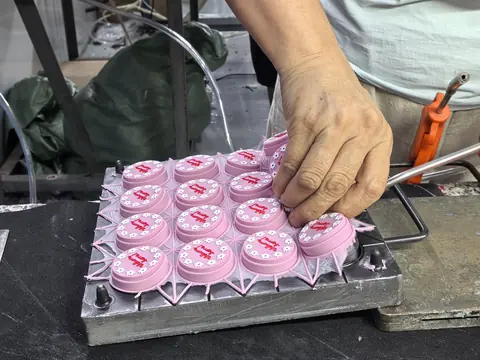
Just out of the press, runner still attached. Trimming happens at the bench, by hand — flash on a visible edge is the reject reason we see most.
What comes out of the tool
Parts from our own moulds, shot on the bench they were trimmed on. Original and generic shapes only — character designs owned by a third party are never shown publicly, see how we handle IP.
-
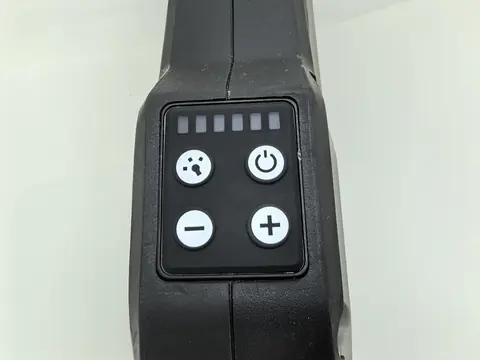
A silicone keypad in its housing. The symbols are printed, the light pipes are moulded into the same shot, and the key webs are cut in the tool. What you cannot see from a photo — how hard the keys press back — is a tooling decision we settle with you before the first shot. -
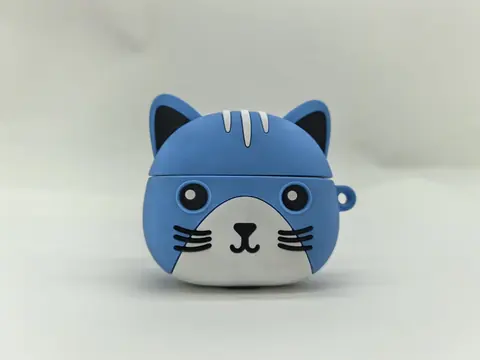
A moulded earbud case. The ears and the loop come out of the cavity in one piece, not glued on. The face is printed after curing. -
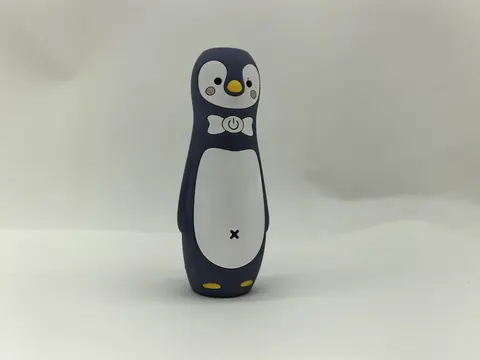
A silicone grip sleeve. The feet are moulded in a second colour, the belly and eyes are printed. Grips like this usually wrap a rigid core — whether yours does is a decision for the drawing, not the photo. -
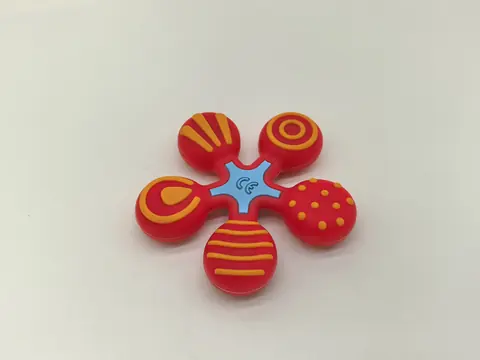
One part, five colours, every petal a different pattern. Parts like this are where colour bleed between cavities shows up first — a red petal would pick up yellow at the boundary if the tool were cut too loose.
Materials we mould
| Material | Process | Best for |
|---|---|---|
| HCR silicone | Compression moulding | Large or thick parts, small batches, lower tooling cost |
| LSR (liquid silicone) | Injection (LIM) | Thin walls, tight tolerance, high volume |
| Soft PVC | Injection or rotocast | Sharp multi-colour detail, hollow designer figures |
| TPU film | Welded | PVC-free waterproof pouches, cold flexibility |
Where your order runs
Our sales, documentation and export team sits in Shenzhen. The plant that presses your parts is our own, in Dongguan — about an hour away. That means you get English-speaking project management and a factory floor you can actually visit, without the two being the same building.
Factory visits are welcome by appointment. If you cannot travel, ask for a live video walkthrough rather than a photo set — on a call we can pan where you ask.
Send your spec, get a quote
Tell us what you need and how many. within 1 business day (GMT+8) — usually much sooner. If you already have a drawing or 3D file, attach it and skip the back-and-forth.
- Email kelen@wintel-factory.com
- Phone +86-755-21011840
- WhatsApp +852 5161 2090